




Pular para o conteúdo
The Technical Founder Kit logoThe Technical Founder KitFrom Doc to Deployed$49
For engineers who want to ship their own product

You can code.

Now Claude Code builds on its own — and drifts on its own.

The agent reads your whole project, writes the feature, fixes the build, and drifts off your architecture just as fast: by session 3 you’ve got a Frankenstein. This kit holds it to the direction you set, with specs it reads at every session start and gates it can’t ignore, from session 1 to 20.

  • Holds the agent to the architecture you set — so autonomy ships your plan, not a new one every session
  • A complete production codebase (auth, plans, payments, admin, async queue) so you don’t start from scratch
  • Built with the exact method I used to ship a working MicroSaaS, solo. The product is the proof, not a tutorial
See the offer — $49
Drifting · session 3
architecture.ts
  // data layer — locked in session 1
- Supabase + Row Level Security
+ // session 3: agent scaffolded Prisma?!
+ // contradicts the schema we agreed on
+ // reverting the architecture. again.
With the kit · every session
CLAUDE.md
# CLAUDE.md — the rules the agent can't drift from

Stack locked. Decisions persist.
✓ 12 Spec Templates
✓ Spec-Driven Workflow
✓ Enforcement Layer
✓ Production Codebase

Built on

Next.jsSupabaseUpstashInngestResendStripeVercel
  • 12 spec templates
  • 1 production codebase
  • 2,193 passing tests
  • 1 methodology guide
  • 2 Claude Code modules

You opened Claude Code with a clear architecture. Then the agent quietly rebuilt it.

The first session feels like magic: the agent reads the repo, writes the feature, runs the tests, fixes the build — on its own. By the third, it’s quietly swapped in an architecture different from the one you chose. By the seventh you’ve got two implementations of the same feature, shipped faster than ever, and no one decided it.

It’s not your fault — and it’s not that the agent is weak. It’s the opposite. The agent is strong enough to rebuild your architecture autonomously, and nothing is holding it to the one you chose. Every session it fills the gaps its own way, and the gaps compound.

You didn’t quit for lack of skill. You quit because nothing held the agent to your plan — and tooling that automates the workflow doesn’t change that: it organizes how the agent works, then watches it drift anyway. More process won’t fix that. The missing piece is an anchor with two layers: a direction the agent reads, and gates that stop it when it strays.

auth.ts
- // session 1: clean auth flow, one source of truth
+ // session 3: agent added a SECOND auth check here??
+ // ...that contradicts the first one. which is right?
An engineer frustrated as a project fragments around them, session after session

The method, in 3 steps

Document first, code second. Every Claude Code session opens by reading the context and closes with decisions on record, so the agent follows a plan you defined instead of improvising one. This is the direction layer: the half of the kit the agent reads. The half that blocks comes next.

Step 01

Document before you code

Fill in the 12 spec templates: business model, PRD, database schema, CLAUDE.md, architecture, design system, tests, events, enforcement policy. Everything the agent needs to build to your plan instead of inventing its own.

12 templates
  • Business model
  • PRD
  • DB schema
  • CLAUDE.md
  • Architecture
  • ADR
  • Session
  • Checklists
  • Design system
  • Tests
  • Events
  • Enforcement
Step 02

Run every session in 3 phases

Phase 0: the agent reads the docs. Phase 1: it validates and flags conflicts. Phase 2: it implements the declared scope autonomously — you review at the end, by reading the branch’s commits. Skip this order and sessions drift.

Phase 0

Reads the docs

Phase 1

Validates & flags conflicts

Phase 2

Implements the declared scope

Step 03

Record every decision as an ADR

Each relevant architectural decision becomes a record: context, decision, rationale, rejected alternatives. Next session, the agent reads the ADR instead of re-litigating what you already decided.

ADR-001accepted

Inngest for async jobs

Context · Decision · Rationale · Alternatives

ADR-002accepted

Supabase RLS over app checks

Context · Decision · Rationale · Alternatives

ADR-003accepted

Idempotent Stripe webhooks

Context · Decision · Rationale · Alternatives

The agent reads these next session

The Enforcement Layer: gates the agent can’t talk its way past

A rule in CLAUDE.md is an instruction the agent reads and almost always follows. "Almost" is the problem: as sessions run long and the codebase grows, written rules compete for attention and lose. The only thing the agent never argues with is a check that fails. So the kit ships a second layer that runs outside the agent’s judgment and blocks instead of warning.

The enforcement ladder: four gates, from cheapest to strongest

  1. 01

    Types

    The rule becomes a type. An invalid state doesn’t compile, and the agent hits the error in the file where it created it.

  2. 02

    Lint rules

    The rule becomes a banned pattern. A forbidden import is caught at the edit, with your reasoning attached to the error message.

  3. 03

    Tests

    The rule becomes observable behavior. "Quota debited only after success" can’t be typed or linted; a test that simulates failure guards it.

  4. 04

    Claude Code hooks

    The rule becomes a gate on the agent itself. Protected edits are denied before they happen, and a “done” with red checks gets sent back to work.

Blocked at the edit
PreToolUse hook
> agent: editing supabase/migrations/004_billing.sql

✗ edit denied
  Applied migrations are history.
  Write a new migration instead.

> agent: creating 140_billing_fix.sql ✓
Blocked at “done”
Stop hook
> agent: "Done. 3 files changed."

✗ stop blocked
  npm test: 1 failed (quota-on-failure)
  The session continues until green.

> agent: restoring debit-after-persist ✓

Not every rule needs a hook, and none of this is a day-1 requirement. The module teaches which rule earns which gate, ships the hooks ready to install, and adds the policy template that maps each hard rule to its gate. Direction gets you started right. Enforcement holds when the project grows past what attention can cover.

I built a real, working MicroSaaS with this, solo, using Claude Code

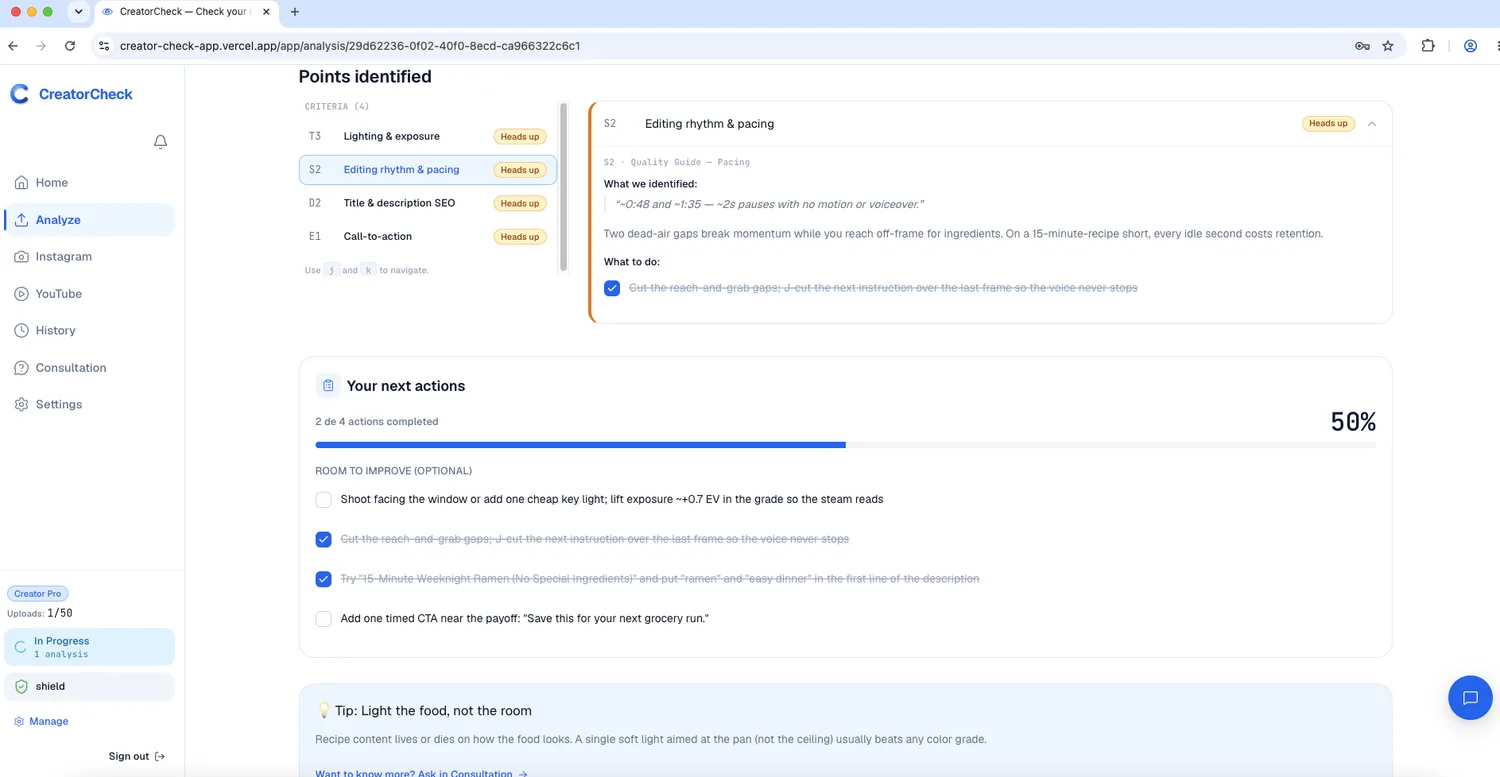
The codebase isn’t a tutorial scaffold. It’s the same approach that built a real, working MicroSaaS, solo. The product is the demo; the codebase you get is what built it.

  • Idempotent Stripe webhooks: the same event fires twice, the customer is charged once
  • Atomic quota functions with pessimistic locking: no race spends the same last credit twice
  • RLS on every table: a user can’t read another’s rows even when a query is wrong. The database enforces it, not your app
  • Async pipeline with retries and prioritized queues: heavy jobs run off the request, failures retry instead of vanishing
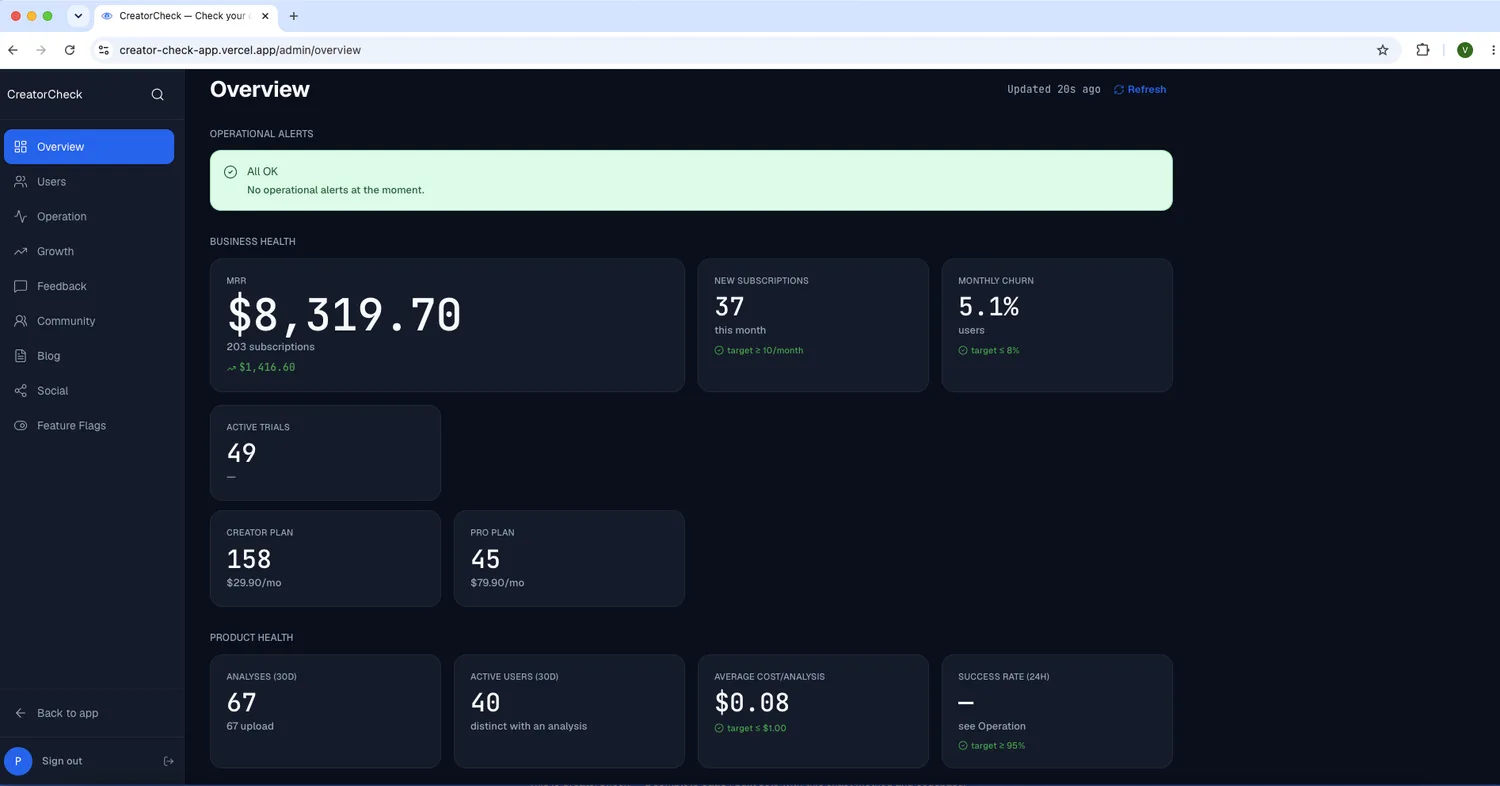
  • Admin dashboard, built once and reused: funnel, errors and users in one place
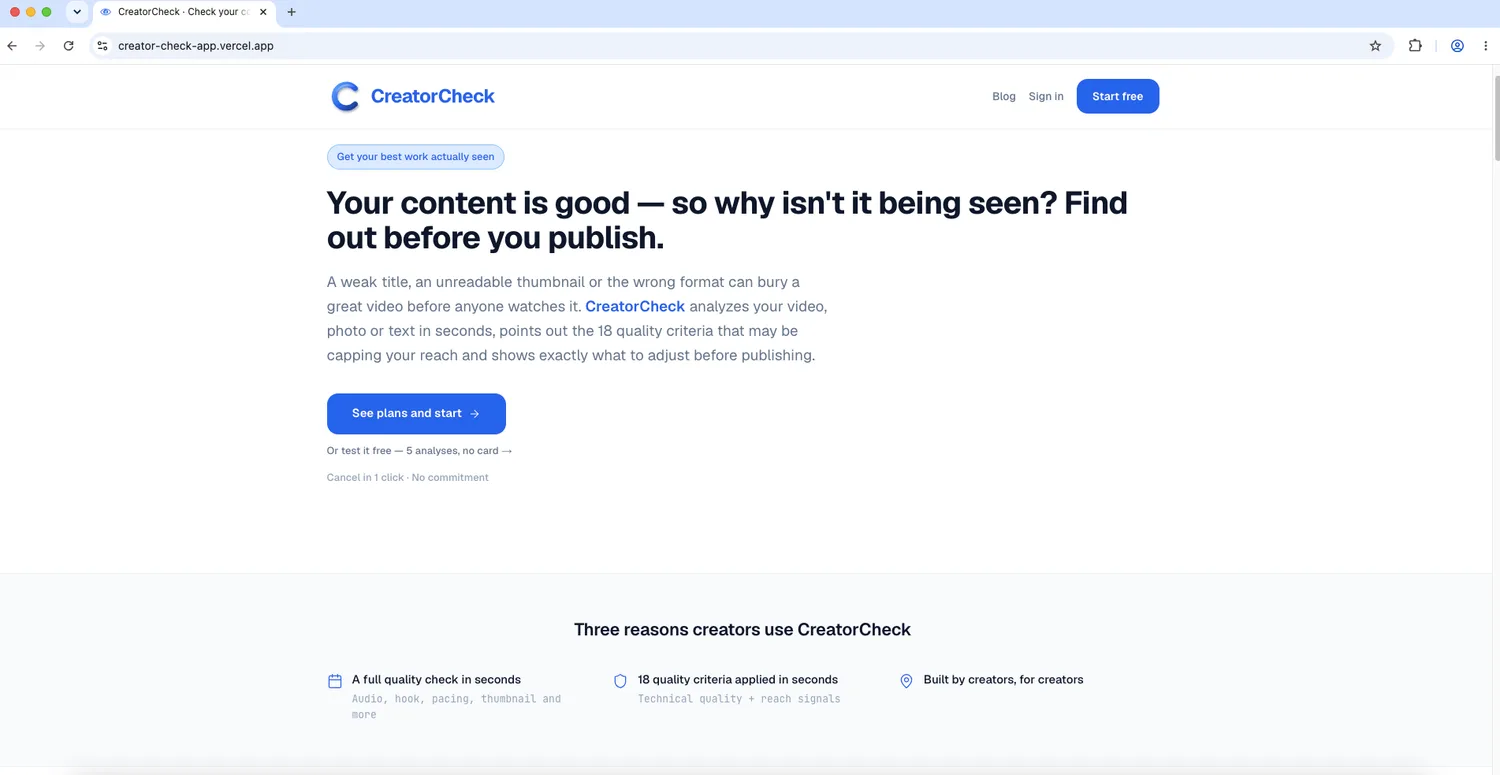
CreatorCheck landing page, live in production
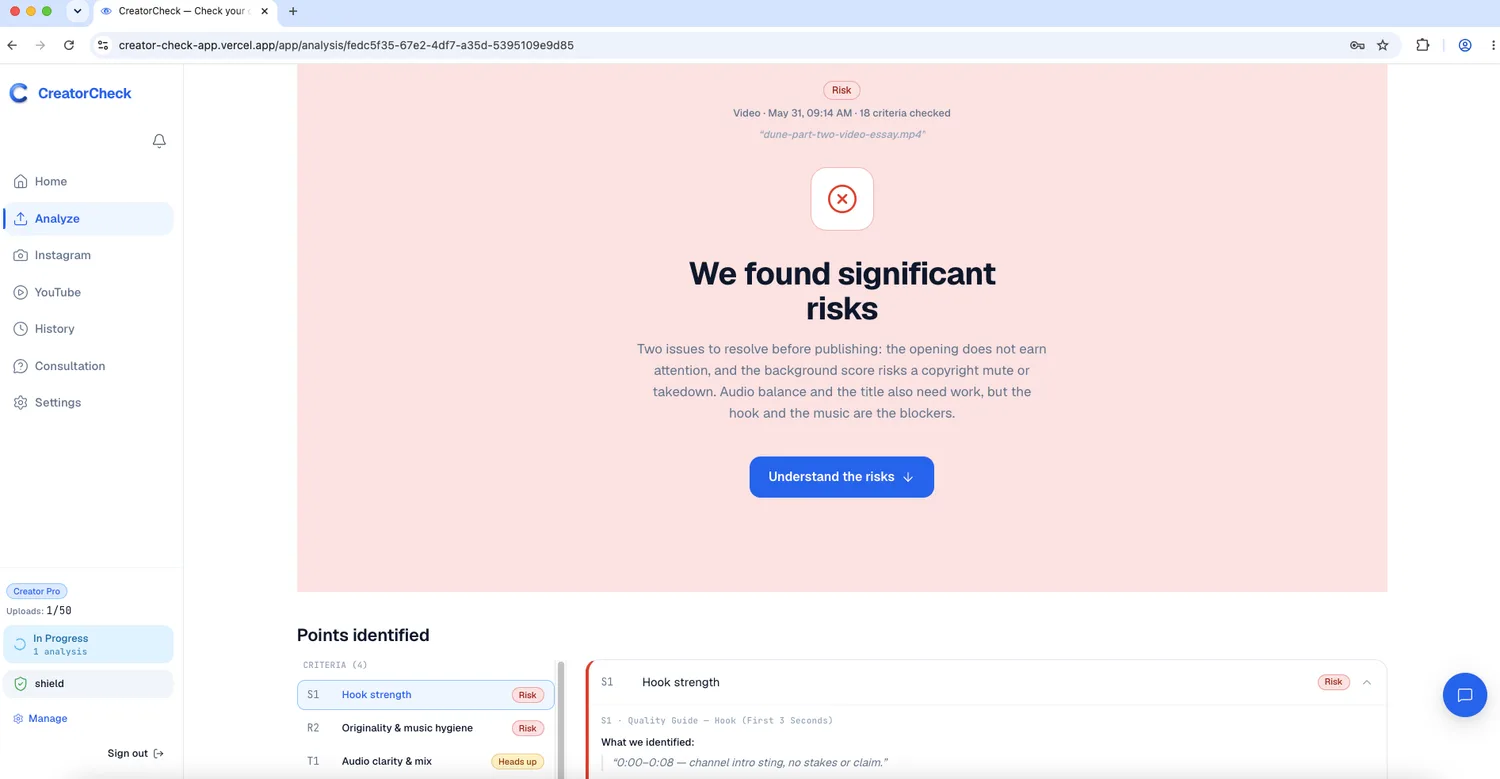
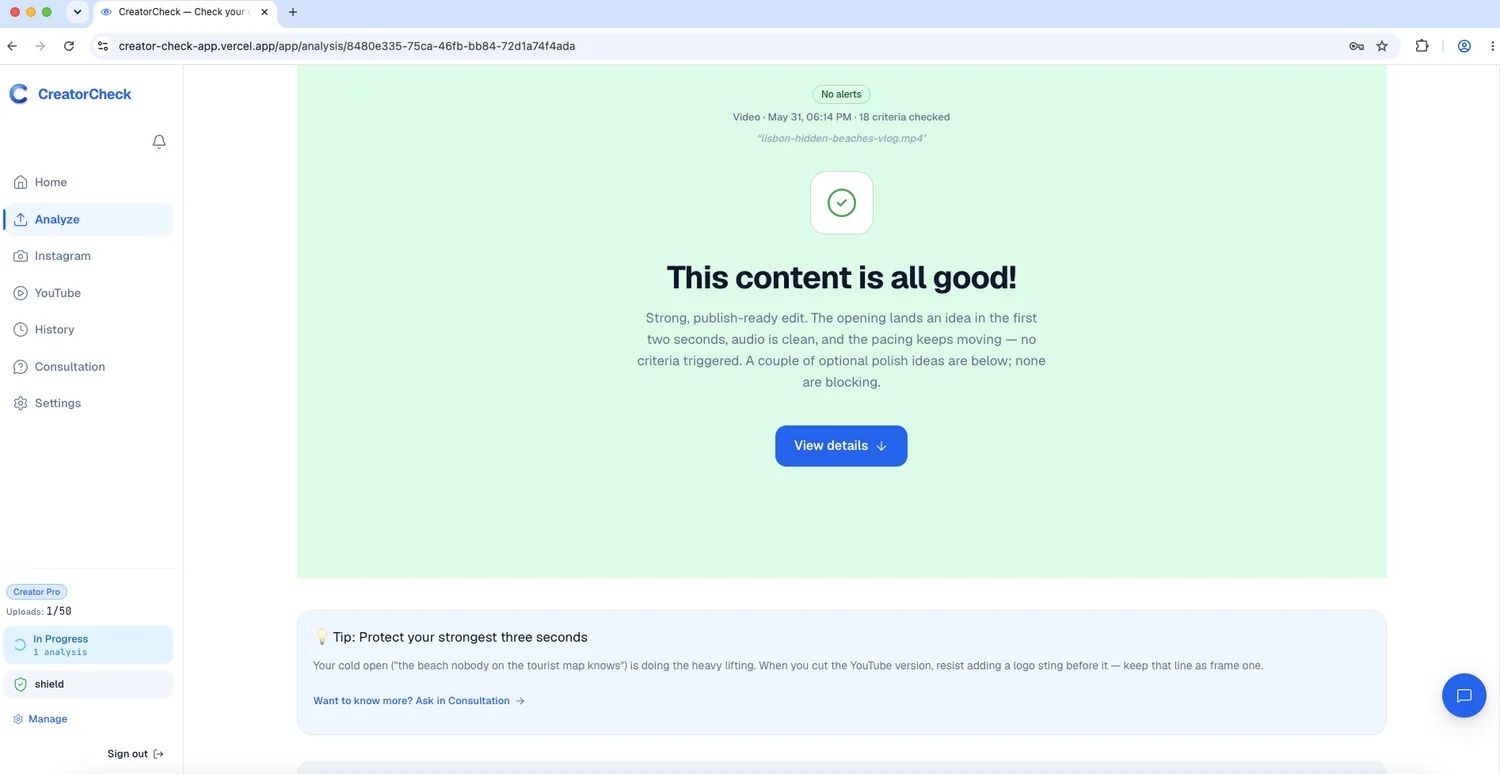
Analysis report flagging significant risks before publishing
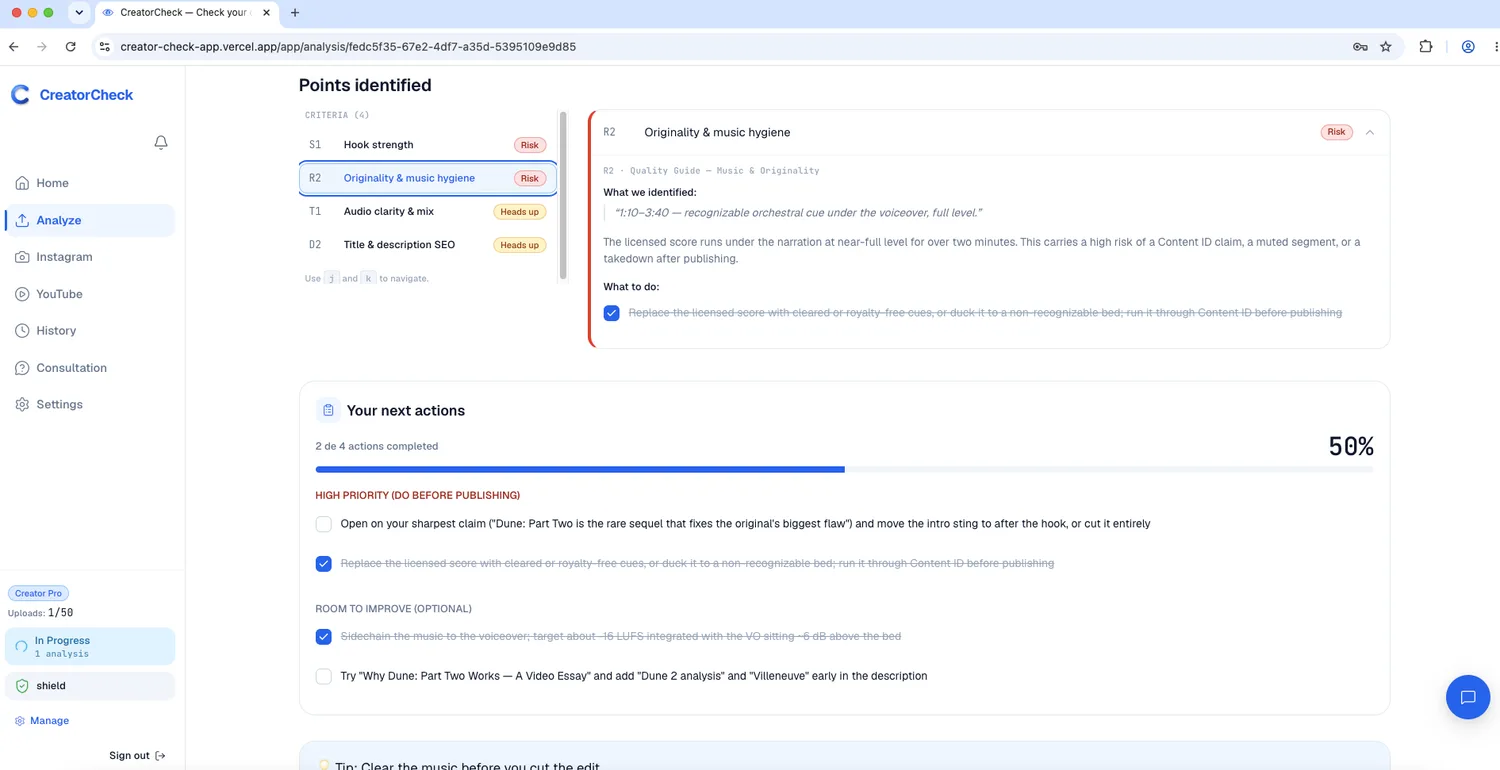
Risk report detail: criteria identified and the next actions to fix
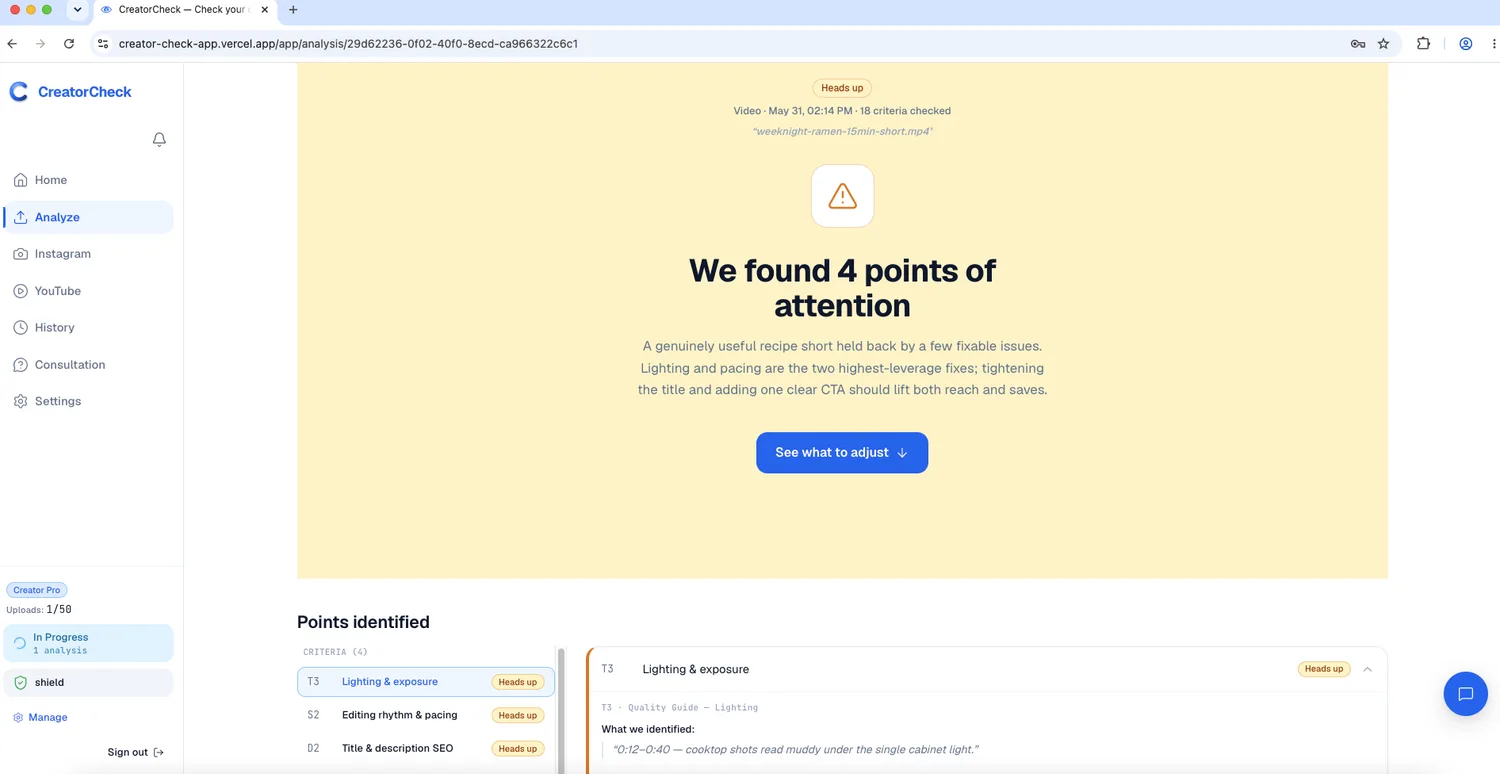
Analysis report with points of attention to fix
Attention report detail: criteria broken down with next actions
Analysis report clearing content that is ready to publish
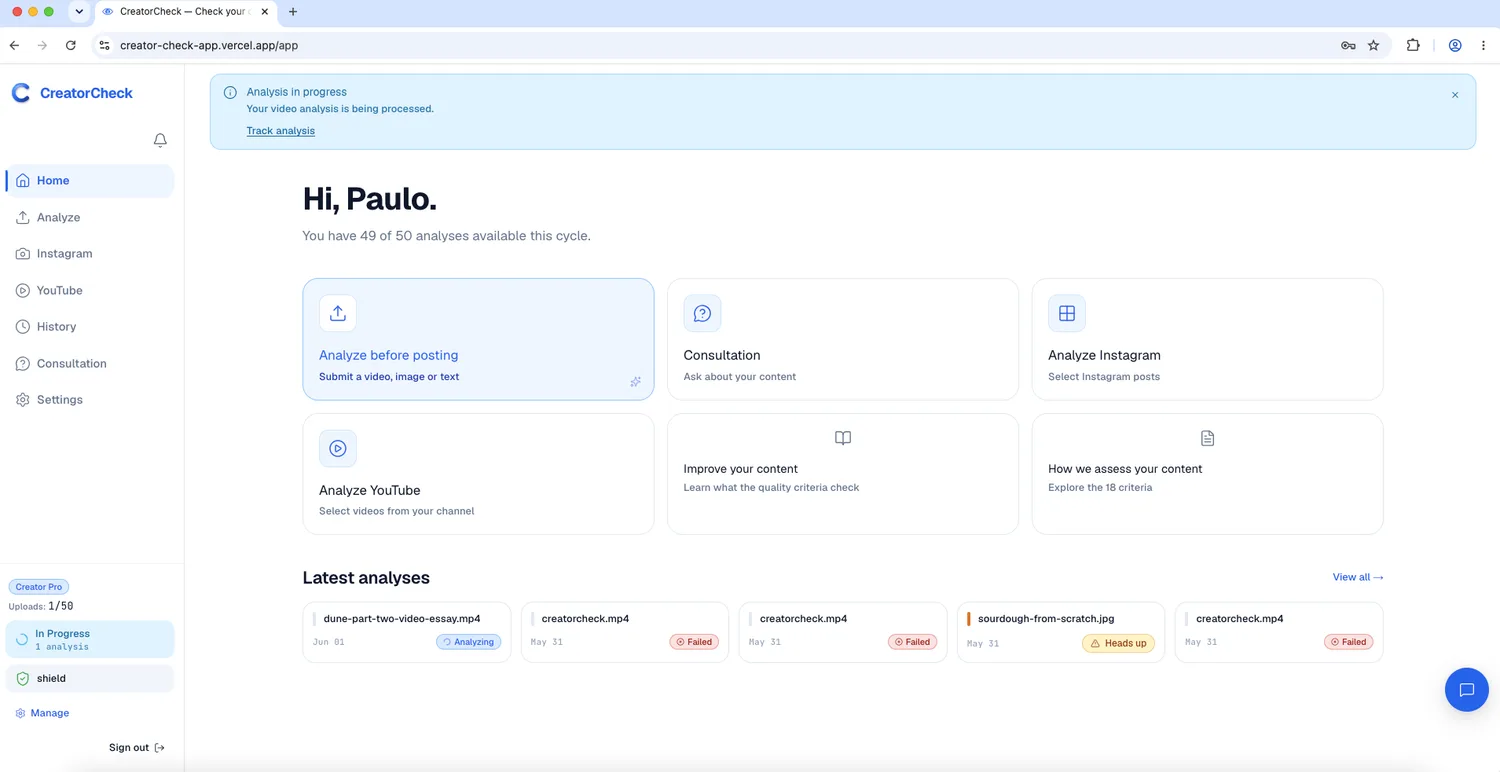
A real CreatorCheck account with analysis history
Admin dashboard showing MRR, subscriptions and churn
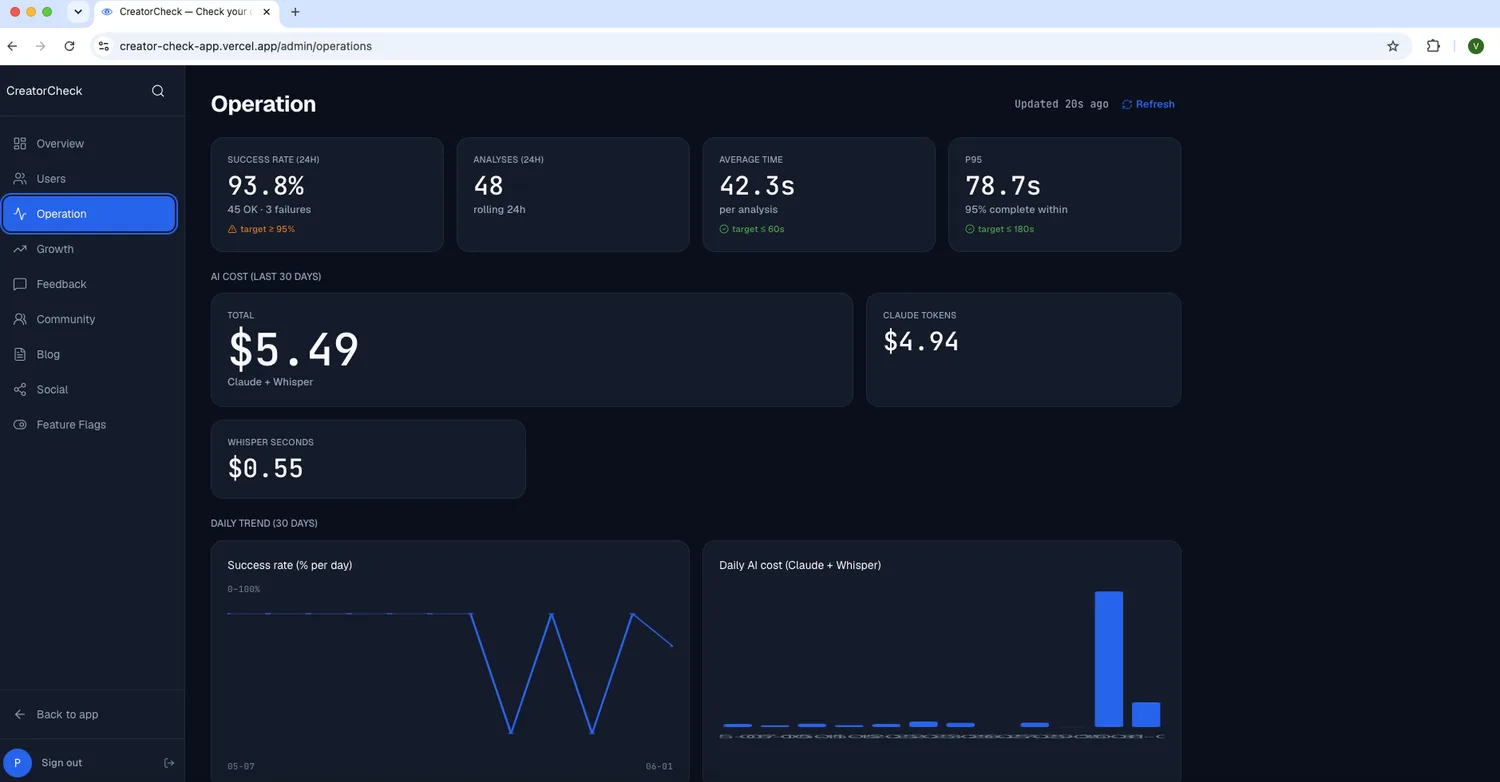
Admin operations: success rate, latency and AI cost per analysis

CreatorCheck — live in production

This is CreatorCheck — a complete SaaS I built solo with this exact method and codebase. The codebase you get is what built it.

Built by one person, one clear idea, and Claude Code. Not a team, not a tutorial.

Everything you need to go from doc to deployed

01

The heart of the method

Pack of 12 Spec Templates

In Markdown, in English, ready to fill in. Each template ships with a worked example so you adapt it to your niche instead of starting from a blank page.

  • 01 · Business model
  • 02 · PRD (in scope / out of scope)
  • 03 · Database schema
  • 04 · CLAUDE.md (the architecture the agent must follow)
  • 05 · System architecture
  • 06 · ADR (Architecture Decision Record)
  • 07 · Claude Code session prompt
  • 08 · Pre-session, pre-deploy and pre-launch checklists
  • 09 · Design System
  • 10 · Testing strategy
  • 11 · Events & Analytics
  • 12 · Enforcement policy (the rule → gate map)
02 · PRD1 / 5
02-prd.md
# PRD: [your product]

## 1. MVP objective
The smallest product that validates the
core hypothesis — in one sentence: [FILL IN]

## 2. MVP features
> Definition of done = observable behavior,
> not a technical task.

Feature 1: [FILL IN]
Definition of done:
- [ ] [FILL IN: observable behavior]

## 3. Out of scope for the MVP
> List what's NOT in now — and for each,
> say WHY. Stops the agent from suggesting
> it in a future session.
- [FILL IN: features left for later]
03-database-schema.md
# Database Schema: [your product]

> Plain language first, SQL second — the
> source of truth Claude Code rereads to
> regenerate SQL, migrations and types.

## Table: profiles
| field       | type    | notes         |
|-------------|---------|---------------|
| id          | UUID    | FK auth.users |
| plan        | enum    | free · pro    |
| quota_used  | integer | this cycle    |
| quota_limit | integer | plan limit    |

Who writes: only the server — never the
user. Plan and quota move via the webhook.
CLAUDE.md
# CLAUDE.md — the agent's context

## Stack (never swap without an ADR)
Next.js · Supabase · Stripe · Inngest

## Hard rules (read every session)
1. No code without a spec in /specs
2. Plan is always read from the DB
3. Quota is debited only after success
4. Every Route Handler validates (Zod)

## Where things live
/specs · the contracts
/docs  · the ADRs
lib/   · the engine
__tests__/ · the rules above
ADR-001.md
# ADR-001: [the decision title]

**Date:** YYYY-MM-DD
**Status:** accepted

## Context
What problem was solved? What made it
hard? Which pressures were at play?

## Decision
One sentence, present tense.
"We use X for Y."

## Alternatives considered
What else was evaluated — and why
each was rejected.

## Consequences
What changes; which trade-offs we
accepted — good effects and bad.
10-tests.md
# Testing Policy: [your product]

> Without this, each session decides on
> the fly. Coverage becomes random.

## What ALWAYS has a test
- Quota rules: reserve, refund, races
- Upload checks: size, MIME, magic bytes
- Route Handler body: Zod + the 400 path
- Price/discount calc, including edges

## What does NOT need a test
- Components that only assemble others
- Visual styles (hover, animation)
- Third-party integrations (real env)
02

The practical playbook

The "From Doc to Deployed" Guide

In English, no fluff. It explains how each template connects to the method and how to run your Claude Code sessions from the first context to deploy.

  • Why the agent drifts off your architecture by session 3 (and how to stop it)
  • The "document before you code" method, explained
  • How to structure Phase 0 / 1 / 2 in every session
  • A full walkthrough of the 12 templates
  • Your first week: a day-by-day plan
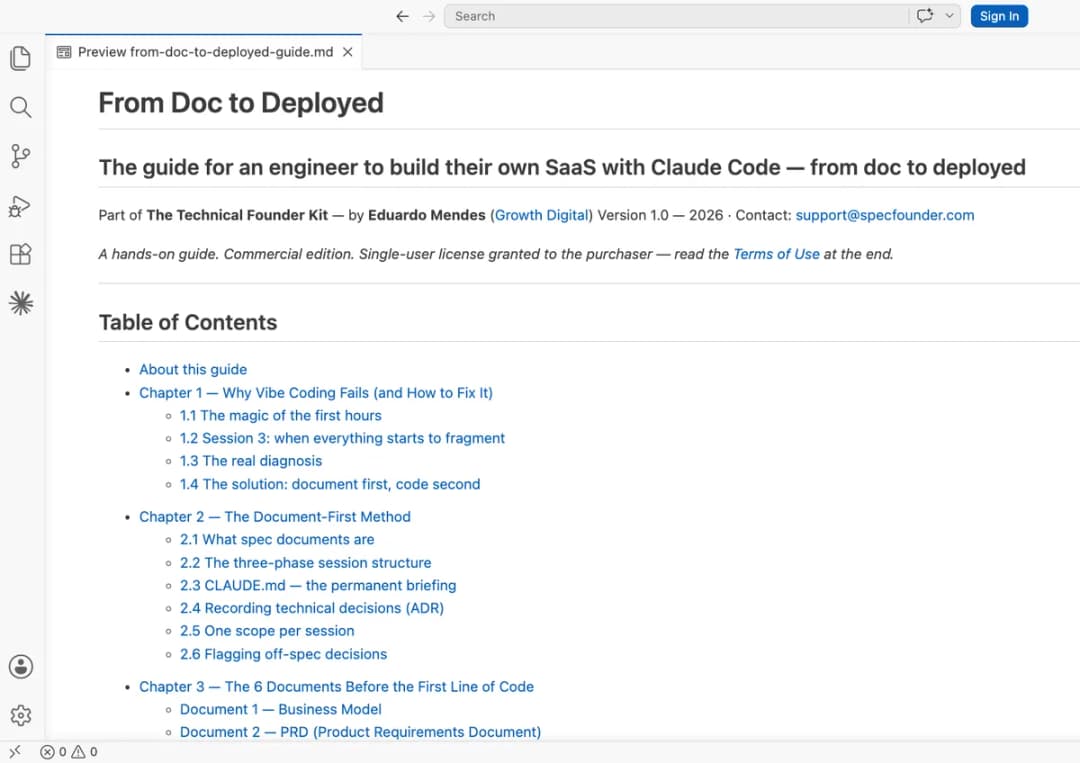
The table of contents of the "From Doc to Deployed" guide
03

The method in action

Spec-Driven Workflow for Claude Code

Most devs hear "spec-driven development" but never actually run it. They don’t know where to start. This is the hands-on training that takes you from zero to a feature you’ve specced, planned, and shipped. It’s built on an open-source spec-driven foundation, with the integration and training that make it production-ready: how the workflow lives alongside your CLAUDE.md, and which ritual to reach for, when. This is the "doc to deployed" method made operational. It’s the ritual the whole kit runs on.

  • Hands-on training: go from zero to a shipped feature, step by step
  • A worked exercise (a real feature) you build alongside the guide
  • Slash commands for the full spec → plan → tasks → implement ritual
  • The bridge: how the workflow coexists with your method, no rule drift
  • A decision table: which ritual to use, when
  • Worked example cases you adapt instead of starting blank
terminal
$ /speckit.specify "receive webhooks from a payment gateway and apply the effect exactly once even with retries"

✓ Created specs/004-exactly-once-webhooks/spec.md
✓ Goal, scope, edge cases, acceptance criteria
→ Next: /speckit.plan
04

The layer that blocks

The Enforcement Layer

Specs tell the agent the rules. This module makes them hold: a short method guide, ready-made Claude Code hooks, and the policy template that maps each hard rule to the check that guards it.

  • The enforcement ladder: which rule earns a type, a lint rule, a test, or a hook
  • Ready-made hooks: protected paths denied, type/lint feedback at the edit, no "done" with red checks
  • An install ritual with tests that prove each gate actually fires
  • The enforcement policy template: rule, typical violation, gate, status
  • When to skip it: early projects earn their gates later, and the module says so
.claude/settings.json
{
  "hooks": {
    "PreToolUse": [{
      "matcher": "Edit|MultiEdit|Write",
      "hooks": [{ "command": "enforce.sh pre-edit" }]
    }],
    "PostToolUse": [{
      "matcher": "Edit|MultiEdit|Write",
      "hooks": [{ "command": "enforce.sh post-edit" }]
    }],
    "Stop": [{
      "hooks": [{ "command": "enforce.sh stop-gate" }]
    }]
  }
}
05

A head start, not a cage

Complete Production Codebase

A full stack ready to run in production: Next.js + Supabase + Upstash Redis + Inngest + Resend + Stripe, hosted on Vercel. Auth, plans, payments, cache, async queue and admin already implemented.

  • Complete auth: email + password, magic link, password recovery, email confirmation
  • Full Google OAuth sign-in flow implemented end to end (not just a button) — tokens encrypted at rest
  • Plans and quotas system (adapt to your model)
  • Direct-to-storage uploads (no 4.5 MB limit)
  • Async pipeline via Inngest
  • Idempotent payment webhooks (Stripe)
  • Transactional email via Resend
  • Admin dashboard with metrics
  • 138 versioned migrations with RLS and idempotent webhooks
  • 2,193 passing tests across 218 suites
  • Step-by-step setup README in English
project structure
the-codebase/
  app/
    (auth)/          # sign-in · recovery
    (onboarding)/    # guided first run
    admin/           # metrics dashboard
    api/             # routes + webhooks
    checkout/        # Stripe checkout
    app/             # the product itself
  components/        # ui · admin · checkout
  lib/
    oauth/           # Google + tokens
    payment/         # idempotent webhooks
    inngest/         # async pipeline
    supabase/        # clients, RLS-first
    upstash/         # rate limit + cache
    email/           # transactional
  supabase/
    migrations/      # versioned, RLS
  __tests__/         # unit + integration

What’s already built into the codebase

You don’t rebuild the infrastructure. You plug your niche’s logic on top of what’s already running in production.

schema.sql
-- RLS: users see only their own rows
create policy "own_rows" on public.reports
  for select using (auth.uid() = user_id);

-- atomic quota check (pessimistic lock)
select * from quotas where user_id = $1 for update;

Auth & payments

Authentication

  • Email + password login
  • Magic link (passwordless)
  • Google OAuth — full sign-in flow, end to end
  • Password recovery
  • Email confirmation

Payments

  • Stripe integration (recurring subscriptions, webhook-driven)
  • Idempotent webhooks with a unique external key (zero double-charge risk)
  • Plans and quotas with atomic functions
  • Full audit trail of plan changes
  • User subscription panel

Data & processing

Database & Schema

  • 138 versioned migrations, ready to run via Supabase CLI
  • RLS on every table (per-user + service_role policies)
  • Atomic quota functions with FOR UPDATE (pessimistic locking)
  • pg_cron for periodic cleanup and daily materialized-view refresh

Processing

  • Async pipeline via Inngest with pessimistic locking
  • Direct-to-storage uploads (no 4.5 MB limit)
  • Automatic retry on failure + prioritized queues
  • Realtime UI while the worker processes in the background
  • Cache invalidated by data change and by deploy version

Third-party integrations

  • Third-party OAuth integrations with a CSRF-protected state handshake
  • Full token lifecycle — encrypted at rest, auto-refresh, revoke & disconnect

Growth & content

Growth & Retention

  • Inline feedback widget with unread badge
  • NPS modal with 90-day cooldown per trigger event
  • 20-slide educational onboarding that resumes where the user left off
  • AI Q&A assistant with per-plan quota

Community

  • Full discussion community: spaces, posts, threaded replies
  • Reactions, @mentions and a notification center (in-app + aggregated email digests)
  • AI content classifier with a failsafe, plus a report → appeal moderation flow
  • Admin moderation: pin, restore, restrict — every action audited

Content engine

  • Automated blog: topic queue, AI-written drafts, hero images generated on the fly
  • SEO built in: RSS, sitemap, schema.org, IndexNow ping on publish
  • Comments + engagement tracking, with an emergency-pause kill-switch

Communication

  • Transactional email via Resend
  • Responsive HTML templates
  • Newsletter lifecycle (welcome, D+3, D+7, weekly recap)

Admin, ops & privacy

Admin & Metrics

  • Dashboard with KPIs per plan
  • 30-day materialized funnel (signup → confirmed → onboarded → activated → paying)
  • Live pipeline + last-24h errors grouped by type
  • User management + audit logs
  • Meta CAPI (server-side conversions) + GA4 server events
  • Daily Meta Ads spend synced into the admin funnel
  • Daily refresh via pg_cron

Launch & feature flags

  • Feature-flag system to gate features per environment or rollout
  • Pre-launch "closed" mode with waitlist capture
  • Emergency-pause kill-switches for risky subsystems

Privacy & consent

  • Cookie consent banner that blocks tracking pixels until opt-in
  • OAuth tokens encrypted at rest (AES-256-GCM)
  • Versioned terms/privacy with an automatic re-acceptance modal
  • Self-serve account deletion with a full audit log

Infrastructure

  • Automatic deploy on Vercel
  • Cache + rate-limit via Upstash Redis
  • Runs on free tier (Vercel + Supabase + Upstash)

Quality & extensibility

Tests & quality

  • 2,193 tests across 218 suites — all green
  • Type-check, lint and tests run before every “done”
  • Coverage focused on the hard rules (quotas, payments, validation)
  • Enforcement hooks included: the same gates, wired into the agent’s loop

Built for you to extend

  • A CLAUDE.md pre-structured with the method’s rules — fill in your project’s specifics and the agent is held to your architecture from session 1
  • README in English (from clone to first deploy)
  • .env.example with comments (every API key explained)
  • Strict TypeScript
  • Zod validation (forms and APIs checked automatically)

The Technical Founder Kit is for you if...

It is for you

  • You already build with Claude Code (or Cursor/Cline) and keep watching it drift from the architecture you set
  • You’ve already bolted workflow tooling onto your agent, and it still drifts
  • You’re an engineer with a side project that stalled, not from lack of skill but from drift
  • You know what to build — the agent keeps rebuilding it its own way
  • You’d trade ten AI tips for one shipped product
  • You want a method that holds, not another boilerplate to wire up from zero
  • You’d rather pay once than subscribe to one more course

It is not for you

  • You want a 10-week video course with a fixed syllabus
  • You want 1:1 mentoring or ongoing dev support
  • You expect a one-click install — no config, no terminal, no README
  • You expect a magic prompt to one-shot the whole app
  • You want the agent to decide what to build — not just how
  • You’d rather collect more AI tips than ship one real thing

Build the right thing — and sell it

You were never going to fail for lack of building skill. You’d fail by building something clean, on time, that nobody pays for. The kit gets you shipping coherently. These two make sure it’s the right thing, and that you can actually sell it.

BONUS · BEFORE YOU BUILD

Niche Selection for Engineers

You can build anything. That’s exactly why you keep building the wrong thing. A filter (not a brainstorm) to pick a niche that pays instead of shipping tech nobody asked for.

  • The 5 traps that catch engineers specifically
  • A 4-question test: is this a niche, or just a project?
  • The 10-conversation validation gate (with a kill criterion)
  • Where your technical edge is a moat, and where it’s worthless
  • A one-page decision sheet to run before you open your editor
A founder filtering many ideas through a funnel down to one validated niche
BONUS · LEARN FROM REAL ONES

8 MicroSaaS Teardowns

Real solo products, real founder-reported numbers, read like a code review, not a motivation reel. What the actual technical core was, what was trivial to build yet printed money, and how they got their first users.

  • 8 real products: PhotoAI, ShipFast, TypingMind & more
  • The stack, the monetization, the first-users channel
  • The pattern that repeats across all 8
  • Why "the building was the easy part," every time
A person studying several MicroSaaS products in exploded teardown view, like a code review

What it’s worth

Paid boilerplates like ShipFast sell for a few hundred dollars, and that’s for the starter code alone. This kit includes a comparable production codebase, plus the method, the 12 templates that tell the agent what to build, and the gates that hold it there.

Everything in the kit, if you sourced it separately:

  • The "From Doc to Deployed" Guide$39
  • Pack of 12 Spec Templates (English)$49
  • Spec-Driven Workflow for Claude Code$39
  • The Enforcement Layer (guide + ready-made hooks)$39
  • Complete Production CodebaseNext.js + Supabase + Auth + Payments + Admin + Queue, plus a versioned SQL schema (138 migrations, RLS, idempotent webhooks)$199
  • Step-by-step Setup README$19
Bought separately$384
In the kit$49

Also included, free:

  • Niche Selection for Engineers
  • 8 MicroSaaS Teardowns
Launch offer

The Technical Founder Kit

Launch price: $49 through July 20, 2026. From July 21, 2026, the kit goes to $79.

$49 one-time

lifetime access, no subscription

Full price $79

after the launch window

GET THE SYSTEM

Built with the exact method I used to ship a working MicroSaaS, solo, with Claude Code. The product is the proof.

  • Instant access after payment
  • 7-day no-questions-asked refund
  • Secure one-time checkout
  • Everything downloadable (Markdown and source code)

You’ll get The Technical Founder Kit in your inbox right away

Instant delivery by email

The moment payment clears, you get the access link. Card payments clear instantly.

No account, no login

You download everything in a single archive. Templates and code live on your machine, ready to use. Nothing locked into a platform.

7-day no-questions-asked refund

Buy it, use all of it, and if it’s not worth it, email us within 7 days for a full refund. No form, no justification.

Be honest with yourself.

Look at your machine and count the projects you started and parked.

How many stalled because the Claude Code session fell apart halfway and the code never came together?

How many you could have unstuck — but the thought of weeks wiring up login, payments and an admin from scratch made you put it off?

And how many could you have shipped in a weekend — if you’d only been sure anyone would pay for them?

If you counted more than one parked project, you already know the problem. And you know that trying again the same way gets the same result.

What you walk away with:

  • The method
  • 12 spec templates
  • 2 Claude Code modules
  • Production codebase
  • 2 bonuses
$49one-time · lifetime access

This is where the loop breaks.

Who built this method (and the SaaS that proved it)

Photo of Eduardo Mendes, author of The Technical Founder Kit

Eduardo Mendes

Full-stack developer and SDET, 18 years at a major national bank, technical lead on Gamification · founder of Growth Digital

I’m a full-stack developer and SDET (Software Development Engineer in Test) with 18 years at a major national bank, where I’m technical lead on Gamification. On the side I run a studio building niche SaaS.

I built a real, working MicroSaaS with this method, solo, using Claude Code. The product is the proof, and I didn’t hire a single developer. These templates are the actual documents I filled in before writing a line of code.

The method isn’t theory. It’s what worked when it was just me, one clear idea, and Claude Code. Everything here was tested, broken, fixed, and documented across months of sessions.

Start this week, not next quarter.

You leave this page with everything you need to start. Session 3 stops being where it falls apart: the agent is held to the architecture it kept rebuilding its own way.

  • The method
  • 12 spec templates
  • Enforcement hooks
  • Production codebase

Everything you get

  • 12 spec templates in Markdown
  • The "From Doc to Deployed" guide
  • Spec-Driven Workflow for Claude Code, with hands-on training
  • The Enforcement Layer: method guide, ready-made Claude Code hooks, policy template
  • Complete production codebase (Next.js + Supabase + Upstash + Inngest + Resend + Stripe + Vercel)
  • Step-by-step setup README
  • Bonus: Niche Selection for Engineers
  • Bonus: 8 MicroSaaS Teardowns
  • Lifetime access, one-time payment
Launch offer

The Technical Founder Kit

Launch price: $49 through July 20, 2026. From July 21, 2026, the kit goes to $79.

$49 one-time

lifetime access, no subscription

Full price $79

after the launch window

GET THE SYSTEM

Built with the exact method I used to ship a working MicroSaaS, solo, with Claude Code. The product is the proof.

  • Instant access after payment
  • 7-day no-questions-asked refund
  • Secure one-time checkout
  • Everything downloadable (Markdown and source code)

Frequently asked questions

Memory tools help the agent recall what happened. They don’t make it follow the architecture you chose — an agent can remember every past session and still drift, because recall isn’t direction. This kit is the method that sets the direction and holds the agent to it, whatever memory layer you run underneath.

Correct, and the kit doesn’t pretend otherwise. Specs and CLAUDE.md set the direction; the Enforcement Layer module adds the checks that block: types, lint rules, tests, and Claude Code hooks that deny protected edits and send a red “done” back to work. The agent can ignore an instruction. It can’t ignore a failing gate.

Workflow tooling structures how the agent works, and it helps. It’s still direction: better instructions, which the agent can still drift from. This kit pairs the direction (specs, session ritual) with enforcement that fires when the agent strays. Different layer, and it runs alongside whatever tooling you already use.

The codebase is Next.js + Supabase + Stripe on Vercel. The method (specs, the anchor that holds the agent, session ritual) is stack-agnostic. Use it with any stack. The codebase is a head start, not a cage.

It’s the same foundation that runs a real, working MicroSaaS I built solo: idempotent payment webhooks, atomic quota functions, RLS on every table, async pipeline, admin dashboard.

Yes. The method is about holding any AI agent to the architecture you chose — including autonomous setups. The session ritual and the spec templates work regardless of the tool.

One-time. Lifetime access to all material. The only recurring cost is your own Claude/Cursor plan.

7-day no-questions-asked refund. Buy it, use it, and if it’s not worth it, email us within 7 days.

You need to be comfortable in a terminal, setting env vars, and reading a README — basic engineering fluency. Not a senior architect. If you’ve shipped anything with Next.js or a similar stack, you’re fine. This is for people who already code.

It’s designed to run on free tiers (Vercel + Supabase + Upstash) until you have real usage, so your early costs are near zero. You pay as you grow, not before.

That depends on you, but the codebase removes the weeks you’d otherwise spend wiring auth, payments and an admin from scratch. Much of the setup is env vars and following the README.

Email support for questions about the templates, the codebase and the method. Not 1:1 mentoring or a review of your specific project. For day-to-day questions while you build, the best tool is Claude Code itself, running in your repo.

Instantly, by email. The moment payment clears you get a link to download everything in a single archive. No account, no login, nothing locked to a platform.

The Technical Founder Kit

From Doc to Deployed

Questions, refunds or support: support@specfounder.com

Terms of UsePrivacy Policy

This kit is an educational product. It does not include 1:1 mentoring, development support or any guarantee of results. The codebase is a starting point; the outcome depends on each buyer’s effort and niche.

Growth Digital

© 2026 All rights reserved.